Red light therapy gets talked about as though it were a treatment on its own. In my studio it is not — it is the last five minutes of a session, and that placement is deliberate.
Everything here is shared for education only — a cosmetic, appearance-focused perspective, not medical advice, diagnosis, or treatment of any condition.
Here is what the light actually does, what it does not do, and why I think it earns its place at the end of the work rather than in place of it.
What red light therapy actually is
Red light therapy — photobiomodulation, if you want the clinical word — uses specific wavelengths of low-level light, typically 630 to 670nm in the red spectrum, with near-infrared reaching further into the tissue. The light is absorbed by the skin and supports the look and feel of vital, healthy-appearing skin.
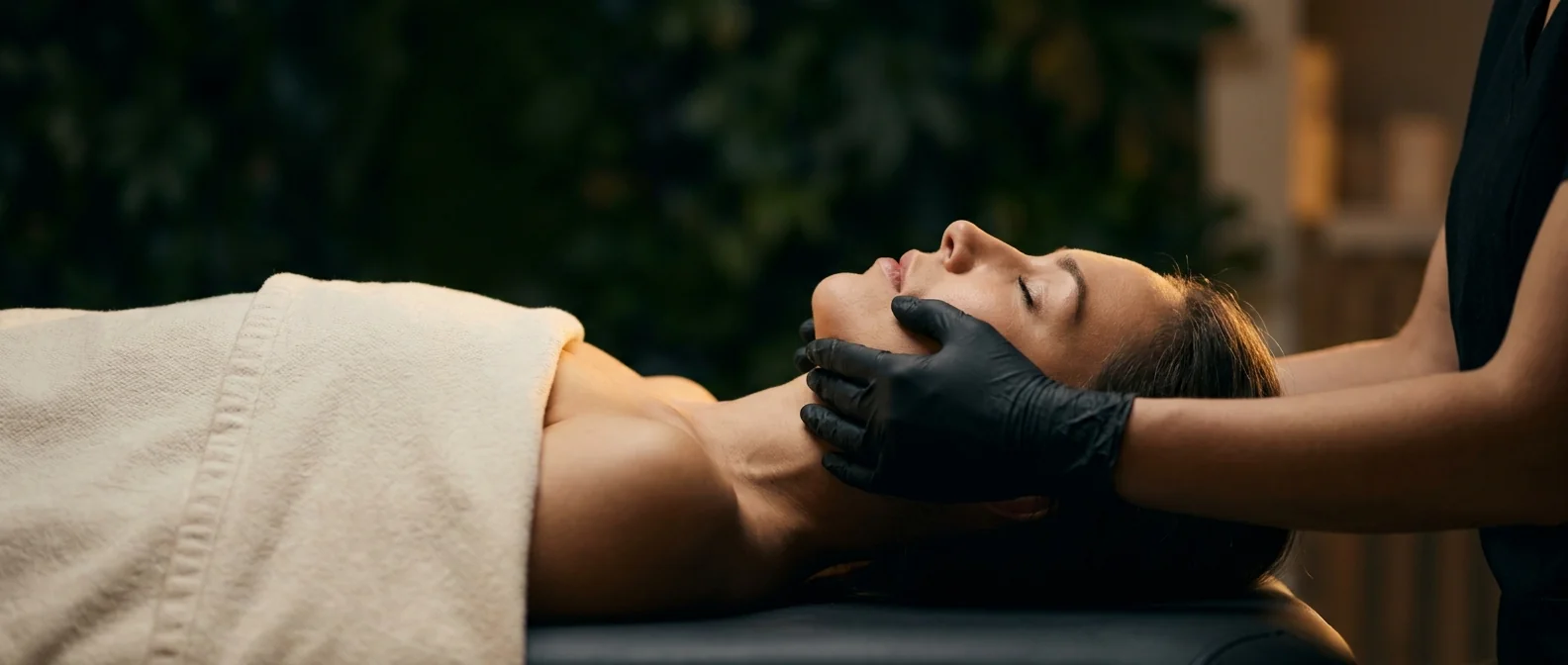
There is no heat to speak of, no abrasion, and nothing to recover from. You lie back with your eyes covered and the panel does the work.
What it does, and what it doesn't
Red and near-infrared light supports the look and feel of healthy, vital skin. In practice that shows up three ways:
- Supports post-treatment recovery
- Supports a calmer-looking skin tone and texture
- Supports the look and feel of firmer, more elastic skin
Now the part most pages leave out. Red light therapy does not produce the dramatic single-session change that hands-on work or microneedling can. It is cumulative and it is quiet.
And the frequency matters more than anyone selling it tends to say. The studies that show visible change run three to five sessions a week for eight to twelve weeks. A red light finish on a monthly facial is not that protocol, and I am not going to tell you it is. If you want the clinical version, that is a home device used most days of the week — not a spa visit.
That is a smaller claim than most pages about red light make. It is also the one I can stand behind.
Why I offer it as an add-on
This is the question I get most, usually phrased as can I just book red light?
You could. I do not think you would get your money's worth.
Red light does its best work on skin that has just been worked on. After buccal technique or lymphatic drainage, circulation is up and the tissue is warm and receptive. Five minutes under the panel then compounds what my hands already opened up. The same five minutes on cold, untouched skin is five pleasant minutes and not much else.
So I built it into the work rather than beside it. That way it lands where it does the most, and you are not paying separately for something that is better as a finish than as an appointment.
Put plainly: five minutes at the end of a facial is worth having. I would rather put it where it works than sell it where it doesn't.
The panel
Clinic-grade, 1,980 LEDs, five minutes, roughly 6 J/cm² delivered to the skin. That is the whole thing — it closes a session rather than filling one.
The dose is the reason five minutes is enough. Photobiomodulation is not a case of longer being better — it follows what the literature calls a biphasic dose response, an inverted curve where too little light does nothing and too much cancels the benefit back out. The useful window for facial skin sits somewhere around 4 to 20 J/cm². Five minutes on this panel lands inside it. Fifteen minutes would not land further in; it would just be ten more minutes.
Where it already comes included
- Skin Longevity Consultation — a red light finish closes the session
- Foundation Package — complimentary with every session
- Maintenance Membership — complimentary with every monthly session
- Any facial on the menu — available as an add-on
Red light therapy in Murray and the Salt Lake valley
Altru Radiance is in Murray, Utah, near Fashion Place Mall, minutes from Holladay, Millcreek, Cottonwood Heights, Sandy and Salt Lake City. Red light is part of how a session closes here, not a room you book by the half hour.
If you are deciding where to start, the Skin Longevity Consultation is 30 minutes, includes the red light finish, and the fee applies toward any service booked within 30 days.
Common questions about red light therapy
Can I book red light therapy on its own?
Not as a standalone session. It is an add-on to any facial, it closes the Skin Longevity Consultation, and it comes complimentary with every Foundation Package and Maintenance Membership session. Red light does its best work on skin that has just been worked on, so I place it where it compounds rather than selling it as its own appointment.
How long is the red light portion?
Five minutes. It closes the session rather than filling one, and there is nothing to recover from afterward — you can put makeup on and go straight back to your day.
Does red light therapy hurt?
No. There is no heat to speak of and no abrasion. You lie back with your eyes covered. Most clients find it the most restful part of the session.
How often would I have it?
As often as you are in for a facial, and I will be straight about what that does and does not buy you. The studies showing visible change run three to five sessions a week for eight to twelve weeks, which no spa schedule matches — that is home-device territory. A red light finish on a regular facial is a good close to the work rather than a course of treatment, which is why it is built into the Foundation Package and the Maintenance Membership rather than sold by the session.
Red light closes the Skin Longevity Consultation, and comes complimentary with every Foundation Package and Maintenance Membership session.
Reserve Your Session